


A call for equal business
Companies founded by women receive only 1% of the venture capital while companies founded by men alone get about 90 times as much . Statistics are completely lacking with regard to the extent to which there is a corresponding purchasing gap, but there is no indication that the situation would be any different there.
In recent years, the discrepancy in the conditions for men's and women's entrepreneurship has gained more and more space in the media, but at the same time the discussion becomes difficult when there are still many prejudices about women's entrepreneurship that hinder an effective solution. Sometimes women entrepreneurs are told that it is important to do something to contribute to change and not just point to problems. As a female entrepreneur you are expected to participate in various initiatives aimed at women or to start a network for other female entrepreneurs so that you can pursue the challenges together. Sometimes you're advised to make lists of women entrepreneurs to show that women really have ideas and can run successful businesses. Common to the benevolent proposals is that it is the women's own problem to solve and in many cases also that the problems are due to something in the women themselves that it is their own responsibility to correct before there can be any change.
One common explanation to the fact that women are so underrepresented among those who receive funding is that women must start more growth companies (i.e. the problem is women's choice of business idea). A growth company is a company that can grow because it has many customers. A fundamental problem for women entrepreneurs, however, is that there is a large purchasing gap that women themselves do not control - it is the rest of us who must decide to buy from the companies that women found in order for their companies to become growth companies. Does it feel complex and difficult? In the end, no company will become a growth company unless the rest of us believe in and support them, at least as customers.
Another explanation often given is that women do not believe enough in themselves or lack role models. What make us believe that it is the women who do not believe in themselves or desperately need role models to dare to take a step outside their comfort zone? The problem probably is due to ourselves not believing enough in the women and not daring to invest in them. But even here we stick the problem on the women themselves - we feel that the many women who start companies (despite abysmal prospects according to all available statistics) still do not believe enough in themselves!
Sometimes what is not said is much more important than what is said and this is especially true when it comes to women and entrepreneurship.
We assume that there are equal opportunities to attract customers, but do not reflect on the fact that in principle no company in Sweden today monitors the proportion of purchases that go to companies with a majority of female founders. What make us think that it is that different from the funding gap? We are not talking about the importance of supporting women's entrepreneurship by becoming their customers or partners to bring about change. Although the solution to having more women-owned growth companies is for more people to buy goods and services from companies owned by women, we have no goal in this respect and do not follow up. Instead, we are showered with initiatives where women should believe more in themselves, get role models, get coaching, pitch, etc. (but which seldom leads to any tangible result).
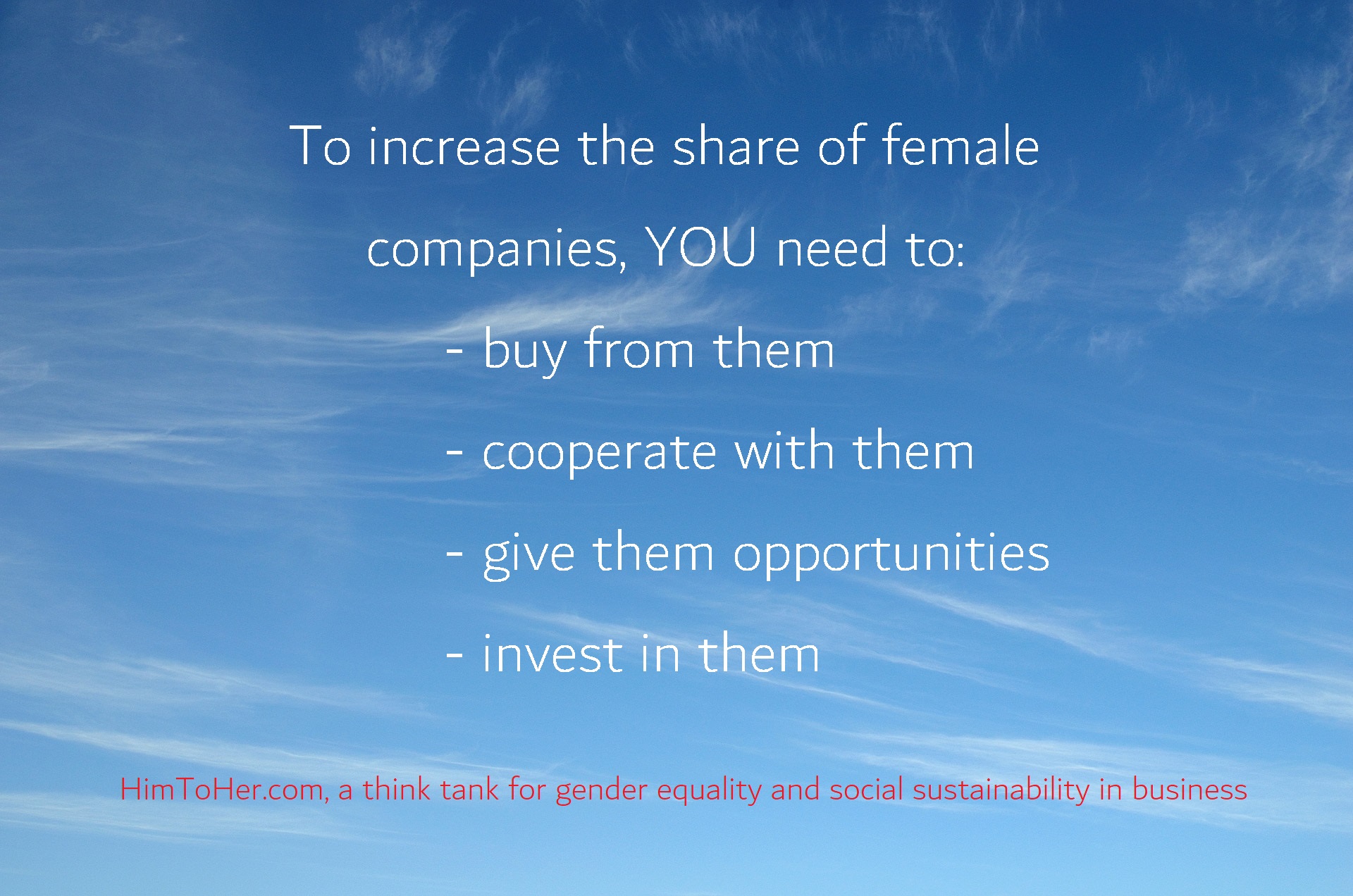
It is important to understand the problem in order to find relevant solutions. Firstly, it is important to identify what the problem really is, but at least as important is to identify who has the best opportunity to solve the problem/who is responsible for the problem. If we believe that someone who does not own the problem can solve it, we will have to wait a very long time for the problem to be solved. That it takes so long time to solve equality-related problems has its explanation in this fact: the problem is owned by those who do not think that the lack of equality is a problem and while those who do not own the problems have to fight like Sisyphus with the stone up vertical walls, those who own the problem can continue to reinforce the walls at a leisurely pace. If the problem of women getting such a small share of the resources for their entrepreneurship is not due to the women themselves, it is a waste of resources to try to change the women - we only play into the hands of those who do not want to contribute to change by agreeing to take responsibility ourselves to solve the problem. If the problem is, in fact, that many do not want to become customers, partners or investors in women's companies, this is where we should invest the resources - both in regulations (for example enhanced competition law and increased focus on social sustainability in sustainable investment), increased focus on training for perceiving preconceived notions, more awareness of the problems and relevant statistics and simply that we increase the pressure on those who can effect change to actually do it.
You easily become someone who stops the party for others when you point out that the problem is not where most people agree that the problem is. The pressure is hard on all of us to fall into line and also repeat the mantra that women must believe more in themselves and dare to start growth companies. Nothing can make you more popular and praised as a female entrepreneur, unless, even better, you also say that you run a business yourself because you want to be a role model for other women. But if there is to be change for real, for everyone and not just a few, then you sometimes have to stop the music and talk honestly. There will be no change if others do not change. We who can become customers, partners and investors but choose not to be. And the best thing we as women entrepreneurs who really want change, for everyone, can do is to refuse to abide by those prejudices which surrounds women and entrepreneurship. To refuse to be the successful exception that is a role model for other women. The best we can do is instead to point out what everyone else - those who own the problem - can do to contribute to change. Become customers, become cooperation partners, become investors and if you can do nothing else: tell others who can be and thereafter follow up.
Female entrepreneurs should put pressure by, for example, opting out of all initiatives aimed at women in order for women to have more opportunities in the startup world (i) if the initiatives are based on notions that women in particular need more experience, more training, more coaching, etc. or (ii) if the initiatives are not based on an adequate analysis of the challenges facing female founders. Instead, women entrepreneurs can point out what initiatives are needed instead. For example: If an organization wants to nominate the Female Entrepreneur of the Year and the like - suggest that they do an initiative instead to nominate the Investor or Customer of the Year for women's companies. Because if it is in any area where role models are needed, it is among those who believe in women and their entrepreneurship. When we made such an initiative in legal tech in 2020, we did not receive a single nomination despite the fact that the post was widely circulated in social media. Perhaps the explanation is simply that there are not that many examples of companies that have invested in female entrepreneurs within legal tech. For the organizations that sponsor events aimed at women entrepreneurs, we can demand that they get involved in a more effective way. The will to do so, however, is terribly low and the interest in telling about the low will is also extremely low. But we give you some examples of the lack of willingness to change from those who have the opportunity to change here and here and here.
As women entrepreneurs, we all contribute to change by continuing to believe in what we do and to continue to run our companies. We also contribute to change by standing up to those who want us to help stick the problem on other women (and ultimately therefore also on ourselves). Others contribute by becoming our customers, our cooperation partners, our investors and, if nothing else, by tipping others so that we have business opportunities. It's not really that difficult.
More from HimToHer
© 2021-2026 HimToHer
Contact us: info@himtoher.com